Background
Many prostate cancer patients experience disease recurrence (lymph node metastasis) after removal of the primary tumor. If the number of metastases is limited and restricted to the pelvic area, surgical removal of these lesions is the treatment of choice. In recent years, the accuracy of this procedure has been greatly improved by using PSMA-targeted radioguided (robotic) surgery. Surgical precision can be further improved by additionally integrating a fluorescent dye into the targeted radiopharmaceutical, allowing complementary shortrange visual detection of tumor-positive lymph nodes and thus even more accurate lesion identification.
Overview Technology
This PSMA-targeted imaging probe combines:
- ahigh-affinity PSMA-targeting moiety,
- a chelator for 99mTc-radiolabeling for preoperative SPECT imaging and intraoperative radioguidance
- a far-red fluorescent dye for real-time intraoperative visualization.
- an optimized overall molecular structure, providing particularly high tumor uptake and suitable tumor/background ratios
Stage of Development
- Preclinical validation completed: Thecompound has demonstrated excellent PSMA affinity, optimized clearance kinetics, high tumor uptake and thus high signal-to-background ratios both in SPECT imaging and in vivo/ex vivo fluorescence imaging in different prostate cancer models.
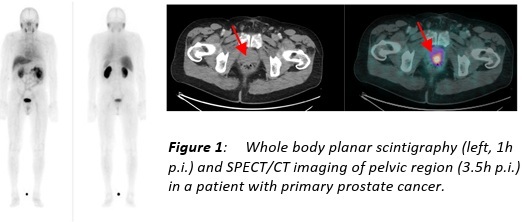
- Clinical trial readiness: So far, three patients have undergone preoperative SPECT and PSMAtargeted radioguided surgery using the compound (see Figure 1). Compared to the non-fluorescent radiolabeled analog, both absolute tumor uptake and lesion-to-background ratios were improved. Dosimetry calculations as well as proof-of-concept fluorescence detection in humans are currently ongoing.
Competitive Advantages
- Dual-Modality Imaging: Enables both nuclear (SPECT/PET) and optical (fluorescence) imaging using one compound.
- Tailored Pharmacokinetics: High tumor uptake and retention improve contrast and detection sensitivity.
- Optimized for Surgical Workflows: Same-day or next-day injection fits standard hospital protocols.
- Improved Surgical Precision: Fluorescence guidance allows millimeter-scale tumor margin visualization.
- Cost-Effective and Scalable: 99mTc is widely available and affordable, making this innovation commercially viable.
Applications
- Oncology & Radiopharmaceuticals: P SMAtargeted SPECT imaging & hybrid surgical guidance (radio/fluorescence).
- Medical Imaging & Diagnostics: Preoperative lesion identification using SPECT imaging and intraoperative radio- and fluorescence guidance.
- Robotic Surgery: Compatible with robotic surgery platforms (e.g., da Vinci Firefly, DROP-IN Gamma probe).
Intellectual Property
Patent applications pending (details available upon request).
Collaboration Opportunity
- Licensing(exclusive or non-exclusive)
- Clinicaldevelopment& regulatory approval
- Commercialization in oncology & imaging markets