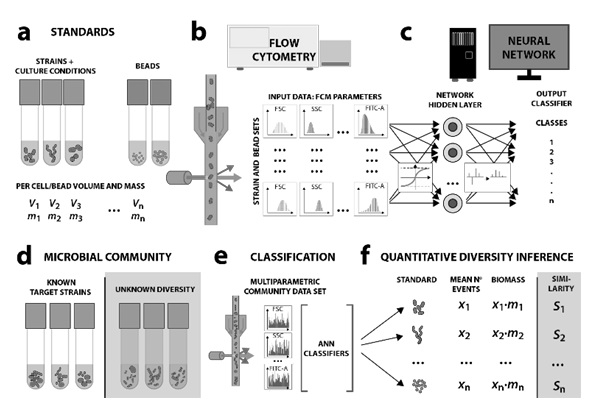
With the increasing realization of the crucial roles played by microbial communities for human, animal, high-throughput methods of microbiota analysis are gaining ever greater importance. However, most of the current ‘omics’ approaches are cumbersome, relatively slow and laborious for quantifying the abundance of at least one microbe in a sample. The inventors have developed a high-throughput methods of microbiota analysis, which is supervised machine-learning ANN pipeline for Flow cytometry (FCM)data, to infer microbial “cell type” diversity in community samples from multiparametric FCM signatures of individual cells, by comparison to signatures of predefined strain and bead standards.
TECHNOLOGY OVERVIEW
This invention is based on the analysis of multidimensional flow cytometry signatures collected on sets of standard microbial strains or beads as pre-defined classes using an artificial neural network (ANN) which was fed with a backpropagation algorithm, producing an output called ‘classifier’. The ANN classifier is used on FCM data from unknown microbiome samples to classify each and every cell in the sample to the pre-defined standard classes with corresponding probability scores. The classification and the probability scores produce the microbial cell type diversity analysis.
BENEFITS
The low-cost, rapidity and ease of FCM quantitative single-cell analysis and fast downstream classification of cell populations makes this a powerful tool to expand and complement routine analysis of microbiota samples in a wide variety of areas including clinical settings.
STAGE OF DEVELOPMENT
Project currently in preclinical stage Technology Readiness Level (TLR4): 4.
COMPETITIVE ADVANTAGES
- Low-cost, quick to install on current Flow cytometers;
- Results comparable to 16S rRNA analysis when classifying the microbiota as eubiotic or dysbiotic
- Allows detection of shifts in microbial communities of unknown composition upon chemical amendment.
- Complement routine analysis of microbiota samples in a wide variety of areas including clinical settings.
INTELLECTUAL PROPERTY
Patent application pending in EU and US Applicant: University of Lausanne
KEY PUBLICATIONS:
Özel Duygan, B.D., Hadadi, N., Babu, A.F. et al. Rapid detection of microbiota cell type diversity using machine-learned classification of flow cytometry data. CommunBiol 3, 379 (2020).
OPPORTUNITY
Weare looking for development partners and offers to grant exclusive or non-exclusive license in the medical field.
REFERENCE
IDF 27-19