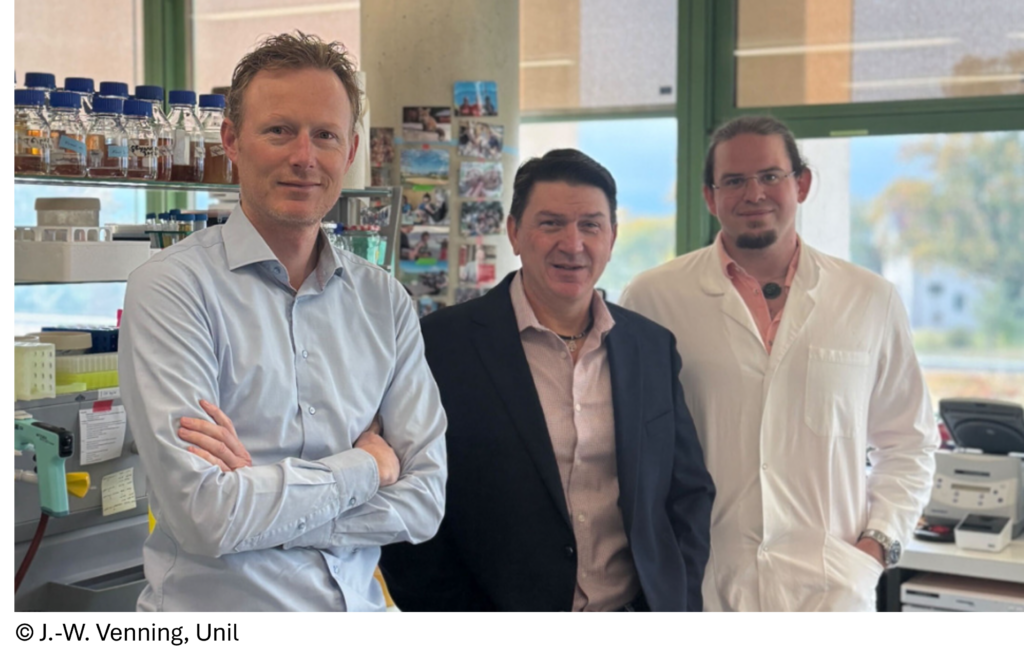


The signing of an exclusive licence agreement between the University Hospital of Lausanne (CHUV) and Prokarium, negotiated by the University Hospital of Lausanne Research Department (PACTT), will enable the joint development of a new treatment discovered at the Department of Urology.
The Research Unit of the Urology Department at theCHUV
(CHP
), led by Dr Denise Nardelli-Haefliger and Dr Laurent Derré, has developed a new treatment for non-muscle-invasive bladder cancer (NMIBC) based on immunotherapy. This therapy involves the use of a Salmonella vaccine administered intravesically to stimulate the immune response against the tumour. (For further details, see the attached publications). In the Department of Urology at theCHUV
, under the supervision of Prof. Patrice Jichlinski, Prof. Beat Roth and Dr Ilaria Lucca, the Salmonella Ty21a vaccine underwent an initial Phase I clinical trial, which demonstrated a good safety profile at the selected dose. (See the Federal Office of Public Health (FOPH) portal dedicated to research involving human subjects in Switzerland
).
Efforts to translate this research into benefits for patients began with the filing of a patent by the Swiss National Science Foundation (PACTT
), which supported the inventors (Dr D. Nardelli-Haefliger, Prof P. Jichlinski and Dr S. Domingos Pereira) throughout the process leading to commercialisation.
The signing of this licence agreement between the Swiss National Centre for Research in the Health Sciences (CHUV
) and Prokarium, a pioneering British biotechnology company specialising in microbial immunotherapy, grants exclusive rights to commercially exploit the patent held by the Swiss National Centre for Research in the Health Sciences (CHUV
). This licence represents a key step towards the development of this innovative treatment.
Read Prokarium’s press release.
Non-muscle-invasive bladder cancer affects 500,000 new patients worldwide each year and accounts for 5 per cent of all new cancer cases. Given the frequent stock shortages of the standard treatment, the Bacillus Calmette-Guérin (BCG) vaccine, it is not always available to all patients. Researchers in the Department of Urology are delighted to continue and expand research and studies into this new Salmonella-based treatment for bladder cancer.
Publications:
Abstract from the Journal of Immunotherapy of Cancer: