
It is the combination of research, a successful clinical trial, and a CHUV patent that has just led to a remarkable international success for the Department of Urology: the administration of a new treatment for non-muscle-invasive bladder cancer has just taken place in the first human patient in the United States.
The treatment is based on immunotherapy and involves the intravesical administration of a bacterium from the Salmonella family to stimulate the immune response against the tumor.
Clinical Trial Underway
Prokarium, a British biopharmaceutical company that develops living medicines using cutting-edge synthetic biology, holds the exclusive license to exploit this CHUV-developed patent. The company is conducting this Phase I clinical trial (PARADIGM-1) in patients with non-muscle-invasive bladder cancer (NMIBC)
The study is being conducted at multiple clinical sites across the United States and will initially evaluate the safety of a single intravesical administration of their experimental immunotherapy.
This study offers great hope for a significant segment of the population affected by these non-muscle-invasive bladder cancers (see below).
A discovery made at CHUV!
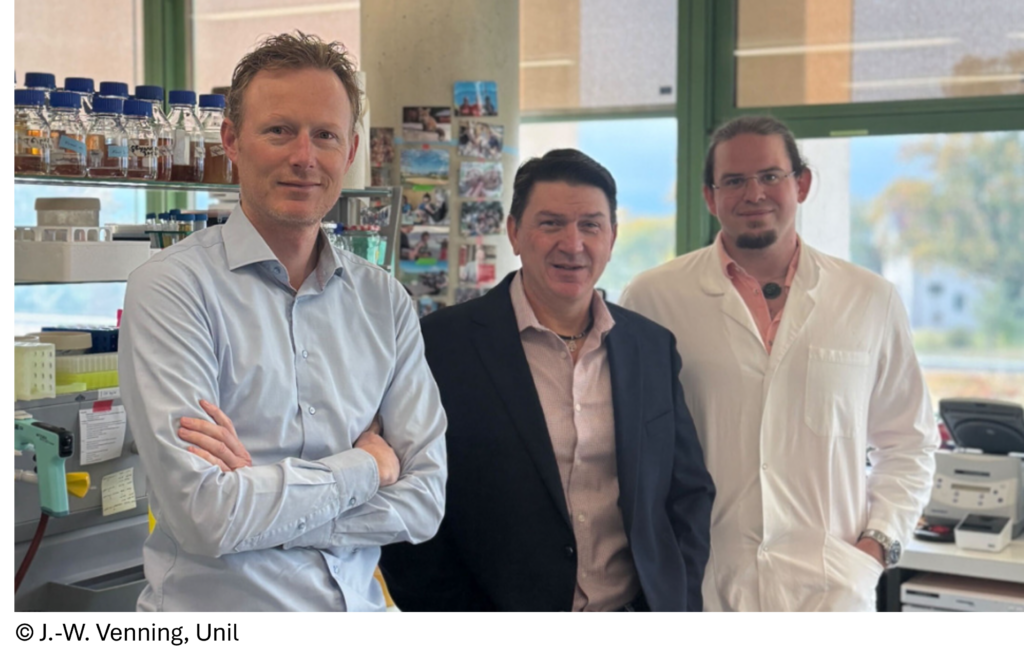
It was originally in the Department of Urology at CHUV—then under the leadership of Prof. Patrice Jichlinski, Prof. Beat Roth, and Dr. Ilaria Lucca (now the acting head of the Department of Urology)—that the Salmonella Ty21a vaccine underwent its first Phase I clinical trial (2018–2021), supported by the Swiss National Science Foundation and an InnoSTEP grant. This trial aimed to establish the safety of the dosage and demonstrate promising immune responses. The discovery of this bacterium’s use against bladder cancer and the patent filed—which laid the groundwork for this success—are attributed to the inventors: Dr. Denise Nardelli-Haefliger, Prof. Patrice Jichlinski, and Dr. Sonia Domingos Pereira.
PACTT, the UNIL-CHUV Office for Knowledge and Technology Transfer, supported the researchers throughout the entire process. It played a role throughout the entire process leading to the commercialization of an invention for the benefit of patients: filing a patent, contributing to the funding of the proof-of-concept study (first Phase I clinical trial) through the award of an InnoSTEP grant, seeking commercial partners, and negotiating option, licensing, and research agreements.
“This marks the achievement of the first milestone outlined in the license, generating returns for the institutions and the inventors, and we are very proud of this accomplishment, which not only recognizes the work of the CHUV research teams but will also enable many patients to benefit from a new, effective treatment,” said Anne-Renée Leyvraz, commercialization manager at PACTT.
Cutting-edge research that makes the CHUV Urology Department proud
“Since the launch of our collaboration with Prokarium in 2019, our team in the CHUV Urology Department has generated a robust set of preclinical data demonstrating that the Salmonella ZH9 bacterium, owned by Prokarium, elicits immune responses that are quantitatively and qualitatively superior, with different kinetics compared to the standard treatment,” said Dr. Denise Nardelli-Haefliger, head of the Urology Research Unit. “Together with Professors Patrice Jichlinski, Beat Roth, Ilaria Lucca, and Sonia Domingos-Pereira, we are delighted to see that the results of our collaboration have the potential to extend the disease-free interval and improve the quality of life for patients with non-muscle-invasive bladder cancer.”
Although the patent for this groundbreaking discovery was filed back in 2013, the signing of the license agreement in 2022 ensures the development and commercialization of this innovative treatment, discovered at the CHUV!
About Non-Muscle-Invasive Bladder Cancer
Bladder cancer accounts for 5% of all new cancer cases in the United States and 550,000 new cases annually worldwide. The clinical stage is determined by the depth of invasion into the bladder wall. More than 70% of cases are diagnosed at an early stage, also known as non-muscle-invasive bladder cancer (NMIBC). Despite early diagnosis, the only approved therapies for this stage of cancer are Calmette-Guérin bacillus (BCG)—which is often in short supply—and various types of chemotherapy, both of which are administered intravesically. Due to its high incidence and the limited number of treatment options, NMIBC remains a huge unmet medical need—one that is poised to be addressed if the results of the ongoing clinical trial confirm their promise of hope.